
About Us

Nebraska is the only 100% public power state in the country – that means we elect the people who make decisions about how we get our electricity and how much we pay for it.
OPPD is owned by the people it serves and has historically delivered electricity at some of the lowest prices in the country. But over the last few years, this has started to change. From tripling the fixed fee on our bills in 2015 to now building significant new infrastructure for big AI data centers – and passing those costs on to us – we are now paying more for electricity than ever before.
This site follows the decisions that are changing Omaha Public Power District and asks whether serving the public is still OPPD’s highest priority.

Data centers: 1% to 41% of OPPD's electricity demand
Nebraska's largest power providers making big bet on natural gas. Data centers a big reason for surg
By Matt Olberding, Nebraska Public Media | June 26, 2025
The Omaha Public Power District said last year that its power-generation needs are expected to grow by 100 MW annually over the next several years. Just a few years ago, that growth was about 4 MW a year.
“Our load growth is increasing substantially,” said Joe Lang, OPPD’s director of generation strategy and origination.
While the Omaha area is seeing more homes and businesses popping up, a large chunk of the electricity demand is driven by power-hungry data centers. Over the past decade, companies including Google, Facebook, Yahoo and Fidelity have opened giant data centers in Douglas and Sarpy counties.
To meet the demand, OPPD over the next few years is planning to add four natural gas-powered turbines: three at its Cass County Station and one at Turtle Creek Station in Sarpy County. All combined will be able to generate up to 900 MW of power, or about enough to power the entire city of Lincoln during peak summer demand.
A recent analysis by Goldman Sachs found that the Omaha area makes up 2% of the world’s power supply dedicated to data centers, the same amount as Chicago, Phoenix and London, even though it’s a fraction of the size of those cities.
a 20% retail rate increase since 2021
Nebraska utilities dealing with energy growth 'we probably haven't seen since post-World War II'
By Fred Knapp, Nebraska Public Media | Dec. 26, 2025
Nebraskans, like many Americans, are dealing with rising demand and prices for electricity.
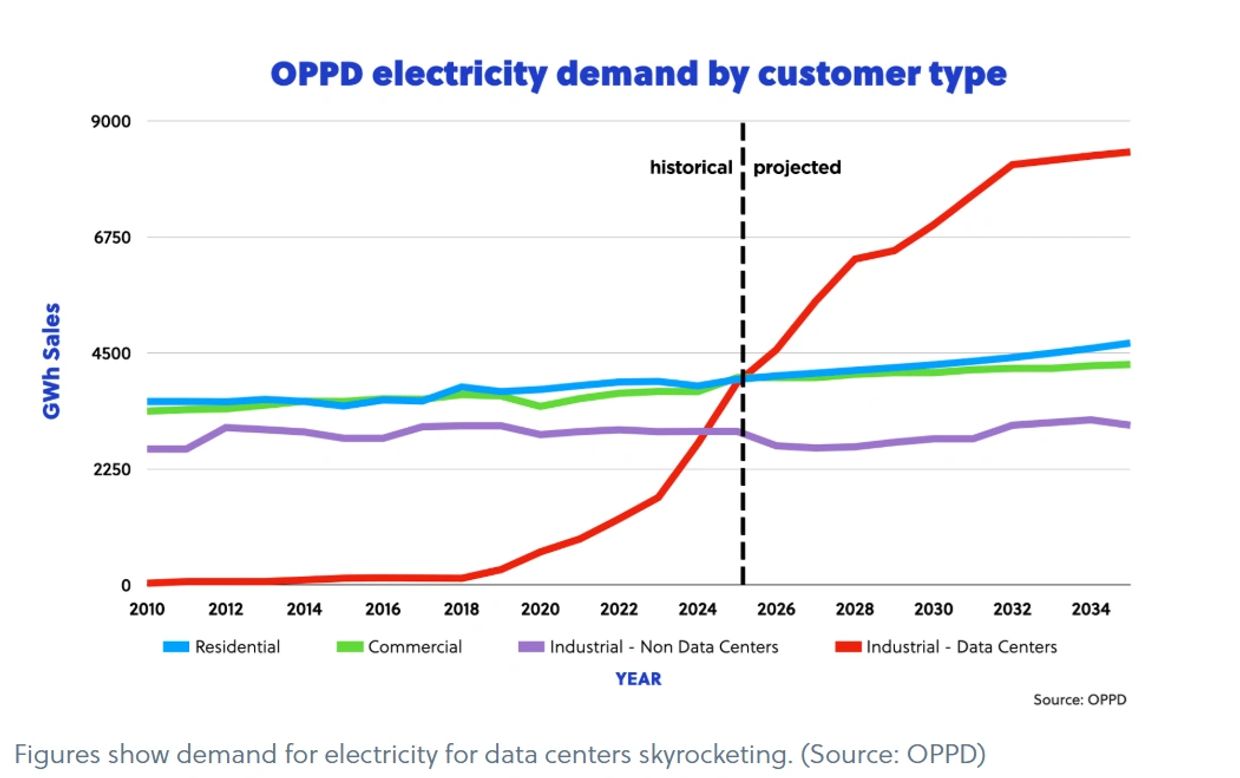
In 2018, data centers used 1% of the electricity sold by the utility. In 2024, they used 21% And by 2035, data centers are projected to account for 41% of OPPD’s electricity sales...
Rising to that demand has involved building generators capable of producing 450 megawatts at Turtle Creek generating station in Sarpy County, with another 225 megawatts on the way, and another 675 megawatts in Cass County. And Lincoln Electric System is planning on installing another 100 megawatts of generating capacity in that city.
All that activity, at a cost of billions of dollars, corresponds with a period of increasing electrical rates... OPPD, after holding rates steady for five years, will have seen around a 20% retail rate increase since 2021.
But OPPD’s Underwood denied that data centers’ skyrocketing demand for power is driving up residential rates.
“The cost of service is a methodical process that we use, that others in the industry use, to make sure that cost-causers are cost- payers, and we get the right cost recovery from the right customer,” he said.
Increased demand from data centers shows up dramatically in sales figures from the Omaha Public Power District.

keeping Old Coal plants open to serve data centers
A Utility Promised to Stop Burning Coal. Then Google and Meta Came to Town.
By Evan Halper, The Washington Post | Oct 12, 2024
Burgeoning demand for the electricity needed to power AI data centers is forcing utilities to reconsider plans and weigh tradeoffs. This is happening in Nebraska, where residents of North Omaha looked forward to the shutdown of a coal-burning power plant because of the area’s high pollution and health issues. However, the local utility delayed the closure because of the need to supply electricity to rapidly expanding data centers for tech giants Meta and Google, which has strained the region’s power grid...
These new data centers, which support the growing AI industry, are overloading the local power grid, prompting the utility to maintain coal usage for longer than anticipated.
An energy crunch forces continued coal burning in a low-income area as data centers strain the regional power supply.
our work started when oppd tripled the fixed fee on our bill
OPPD approves controversial rate increase
KETV Omaha | Dec 17, 2015
The price for Omaha residents to power their home or business will go up in 2016.
The Omaha Public Power District Board of Directors approved two resolutions Thursday that will affect future bills.
One is a general rate increase; the other is a rate restructure, taking service fees from the current $10.25 per month to $15 per month starting in June.
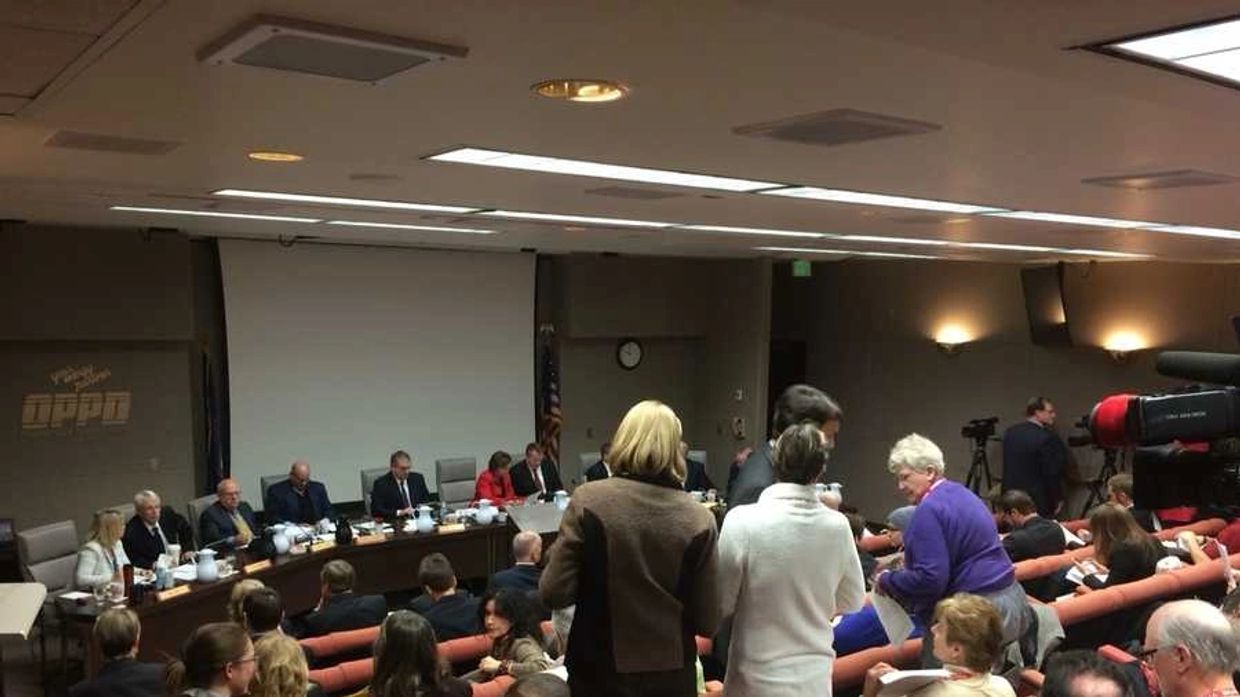
Customers packed the board meeting. Most of them were out of their seats when public discussion was opened over OPPD's rate restructure.
Dozens spoke out, saying the hike hurts low-income and low-use customers.